📖 The Story Behind the Hack (2002–2003)
Back in 2002, PC motherboards (like the ASUS P4 series and ABIT boards) almost all came with an internal 5-pin IR_CON header on the PCB. But retail IrDA desktop dongles were ridiculously expensive ($40–$60), and practically no one sold just the transceiver module to plug into the motherboard header.
At work, we had recently purchased a fleet of HP LaserJet 4050 enterprise printers. Each printer box contained a request card for a free HP C4103A Infrared / Fast IR (FIR) adapter pod. We ordered them, ending up with about 10 of these pods sitting in our IT supply room.
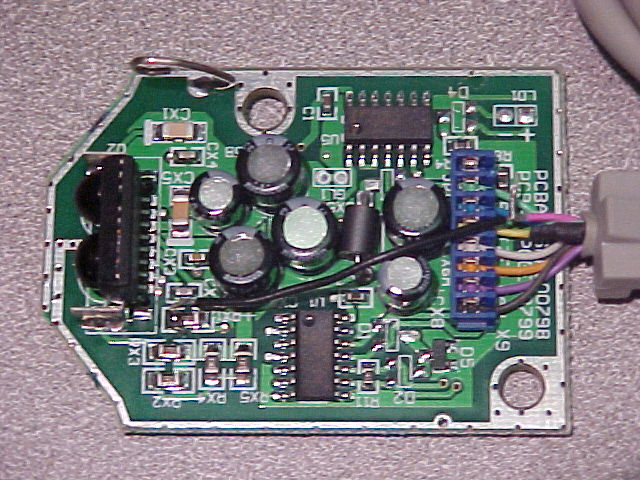
As an actual printer accessory, they were practically useless (I never once got them to reliably print wirelessly from a laptop). But cracking the plastic casing open revealed serious hardware: * HP HSDL-1100: An HP 4Mbps IrDA 1.1 compliant optical transceiver. * Fairchild MM74HC04: A Hex Inverter IC. * National Semiconductor DS90LV019: Low Voltage Differential Signaling (LVDS) driver/receiver.
HP had designed the pod to use differential signals over a proprietary 8-pin mini-DIN cable. But by bypassing the LVDS chip and tapping directly into the hex inverter and HSDL-1100 transceiver, we could convert the unit into a standard 5V CMOS/TTL serial IrDA transceiver for any desktop motherboard for pennies.
So far, it worked great to sync my Nokia 3360 mobile phone and my HP Jornada Pocket PC PDA!
📐 Component Layout & Schematics

The internal module contains the HSDL-1100 optical transceiver and the MM74HC04 inverter.
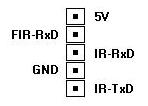
Standard Motherboard 5-Pin Header Pinout:
- Pin 1:
+5V VCC(Power) - Pin 2:
FIR / NC(Fast IR or No Connect) - Pin 3:
IRRX(Infrared Receive) - Pin 4:
GND(Ground) - Pin 5:
IRTX(Infrared Transmit)
🛠️ Step-by-Step Conversion Instructions

⚠️ CAUTION: Even though the original HP plug looks similar to some motherboard connectors, do not plug it in directly without modifying it—it will short 5V to ground and blow a motherboard fuse.
- Disassemble the Pod: Pop open the black plastic snap-fit enclosure.
- Remove the HP Cable: Desolder or cut the original 8-pin printer cable.
- Wiring the Ground & 5V Power:
- Solder a wire from Pin 4 (GND) of your motherboard cable to the common ground pad on the PCB.
- Solder Pin 1 (+5V VCC) to the input power trace leading into the HSDL-1100 transceiver.
- Tapping the IRTX & IRRX Signals:
- Solder the IRRX (Receive) wire directly to the output pin of the HSDL-1100.
- Solder the IRTX (Transmit) wire through the MM74HC04 inverter to invert the motherboard’s TX pulse to match the HSDL-1100 active-low requirement.
- BIOS Setup:
- Enter your motherboard BIOS (Award / AMI / Phoenix).
- Go to Integrated Peripherals -> UART 2 Mode (or COM2).
- Set UART 2 Mode to
IrDA(orHPSIR/ASKIR). - Set RxD, TxD Active to
Hi, LoorLo, Hidepending on your motherboard spec.
❓ Frequently Asked Questions (From the 2003 FAQ)
Q: Can I connect this to a standard RS-232 9-pin Serial (COM) port?
A: No, not directly. RS-232 uses ±12V bipolar voltage levels which will destroy the 5V CMOS chips. The motherboard IrDA header uses 5V TTL and connects directly to the internal Super I/O chip UART with built-in IrDA encoder/decoder hardware.
Q: Can I use this for Consumer IR (TV Remote Control signals)?
A: IrDA (115.2Kbps / 4Mbps with 3/16th pulse duration) operates on a completely different carrier frequency than 38kHz / 40kHz Consumer IR (CIR) remote controls. While it can transmit some raw pulses, dedicated CIR receivers are better suited for home automation remotes.
Q: What speeds does it support?
A: In Standard IR (SIR), it runs at 115.2 Kbps. In Fast IR (FIR) mode with motherboards supporting DMA channels for IR, the HSDL-1100 transceiver is rated for up to 4.0 Mbps.
🤝 Acknowledgments & Credits (2002)
Special thanks to the early European hardware modding community—especially Dschen Reinecke, Ralf Probst, and Andreas Schöler—whose early German schematics and translation notes helped crack the HP LVDS pinout.